

When a patient finds a clinical trial and writes to the contact listed for it, how often does anyone write back? To find out, AllClinicalTrials.com sent about 35,000 inquiries to study contacts listed on ClinicalTrials.gov. About a third never even reached a working inbox, and that turned out to be only part of the story. Here is how we did it, what we found, and what patients and study teams can do about it.
Looking for a study that will reply?
Studies marked “Active & Responsive” on AllClinicalTrials.com have a track record of answering patients.
Why we looked at the first message
When people talk about why clinical trials struggle to enroll, they usually talk about awareness, strict eligibility rules, or patients who are hesitant to take part. Much less attention goes to a simpler question: when a patient finds a study and writes to it, does anyone write back? For many people, that first email is the moment they decide to try. If it goes unanswered, the path to a study can end before it begins, even for someone who is motivated and eligible.
This step is almost never measured, so we set out to put a number on it, looking at the experience the way a patient would.
How we did it
We used what researchers call a simulated patient, or mystery shopper, approach. Over three months in summer 2026, about 35,000 short inquiries were sent to the contact email addresses listed for studies on ClinicalTrials.gov. Each message was written the way a prospective participant would write: it expressed interest in a specific study and asked how to take part.
This kind of approach is long established in research on access to health care, because telling people in advance that they are being tested would change the very thing being measured. We kept the process to a single step: there were no screening calls, visits, or attempts to enroll, and we report the results only in aggregate. The aim was not to judge any study's quality or science, but to understand one practical part of the patient experience.
What we found
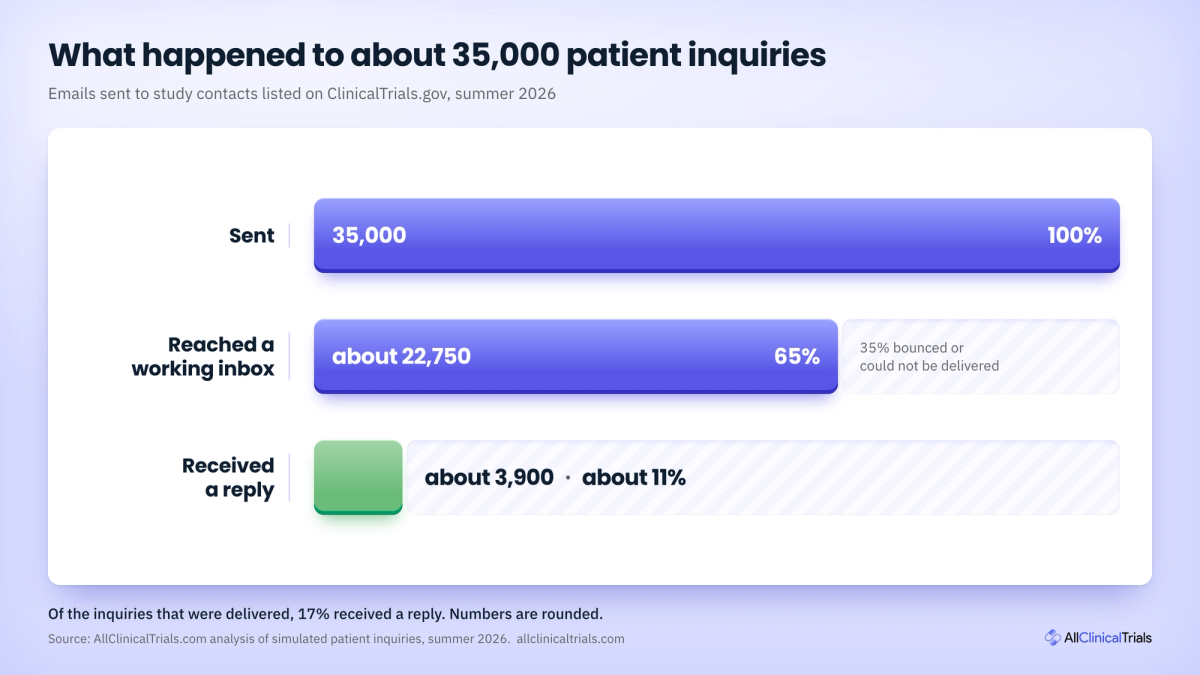
Source: AllClinicalTrials.com analysis of simulated patient inquiries, summer 2026.
About a third of the messages never reached a working inbox. Roughly 35% bounced or could not be delivered. Some of this likely reflects contact details that are out of date, since coordinators change roles or institutions and registry records are not always updated when they do. Some may also reflect institutional email systems rejecting or filtering messages, which we could not fully separate.
Of the messages that were delivered, 17% received a reply. Put together, that means about 1 in 9 inquiries got a response. In practical terms, a patient writing to studies like these would, on average, need to contact around nine of them to hear back from one. For someone already managing an illness, appointments, and uncertainty, that is a real barrier.
Responsiveness was far from uniform. While most inquiries went unanswered, some study teams replied promptly and clearly. That difference suggests a slow or missing reply is not an unavoidable result of regulation or workload, but often a matter of process and priorities.
Why it matters
Recruitment is already one of the hardest parts of clinical research. A Tufts Center for the Study of Drug Development analysis of more than 150 studies found that 89% of trials eventually reach their enrollment goals, but usually only after nearly doubling their original timelines (Tufts CSDD, 2013). And of 2,579 phase 2 and 3 trials that closed in 2011, 19% were stopped for poor enrollment or finished well below their target (Carlisle and colleagues, Clinical Trials, 2015).
Yet patients are often more willing than the system assumes. In a nationally representative US survey, only 9% of adults had ever been invited to join a clinical trial, but nearly half of those who were invited took part (Williams and colleagues, JAMA Network Open, 2021). In a 2026 Harris Poll for Patient Advocate Foundation, 71% of US adults said they would be likely to take part if given the chance, yet 64% of those with chronic conditions said their provider had never discussed clinical trials with them (PAN Foundation, 2026). People who take the initiative to write to a study are exactly the people recruitment efforts hope to reach, and each unanswered message is a missed opportunity for the study and a small loss of trust for the patient.
What these numbers can and cannot tell us
These findings describe one channel, email, at one point in time. A failed delivery does not always mean an outdated address, since some messages may have been blocked by email systems, and a delivered message may still have landed in a spam folder. Many study teams also rely on phone lines, central recruitment services, or referrals from doctors, so a missing email reply does not always mean a study was impossible to reach. Some studies may have been nearly full or no longer enrolling at certain sites, even though they were still listed. The analysis was also not designed to compare individual sponsors, sites, or diseases.
Even with those limits, the size of the gap is hard to ignore, and it points to a step in recruitment that can be improved with relatively simple changes.
What patients can do
If you write to a study and hear nothing, it usually says more about the study's process than about you. It helps to reach out to several studies at the same time rather than waiting on one, and to try a phone number if one is listed, since many teams respond faster by phone. The research office at your local hospital or clinic can often point you to the right person, and a referral from your own doctor can open doors that an email cannot. Keep the first message short, mention the study you are interested in and where you live, and follow up once if you have not heard back after a week or two.

Our guide explains how to volunteer for a clinical trial.
What study teams and registries can do
Answering patient inquiries is part of recruitment, not an extra task on top of it. A shared study inbox instead of one person's address keeps contact details working when staff change. Checking registry contact information regularly, especially when a coordinator moves on, prevents messages from disappearing. A simple standard, such as replying to every inquiry within a few business days even if only to say the study is full, makes a real difference to patients, and tracking inbound inquiries alongside other recruitment numbers makes unanswered interest visible. For registries and trial platforms, the findings point to the value of checking that listed contacts actually work, not only publishing them.
About this analysis
This analysis was conducted by AllClinicalTrials.com, a platform that helps patients find and apply to clinical trials. Because we run a trial search platform, we have an interest in how easily patients can reach study teams, which is why we describe the method in full and report the results only in aggregate. The findings led to one change on our platform: studies that consistently reply to patients now carry an "Active & Responsive" label, so patients can see which teams are likely to answer before they reach out.