
Is your FibroScan between 10 and 20 kPa?
That range is exactly where a large liver study is recruiting right now. It is testing whether two medicines can prevent scarring from progressing.
What a FibroScan actually measures
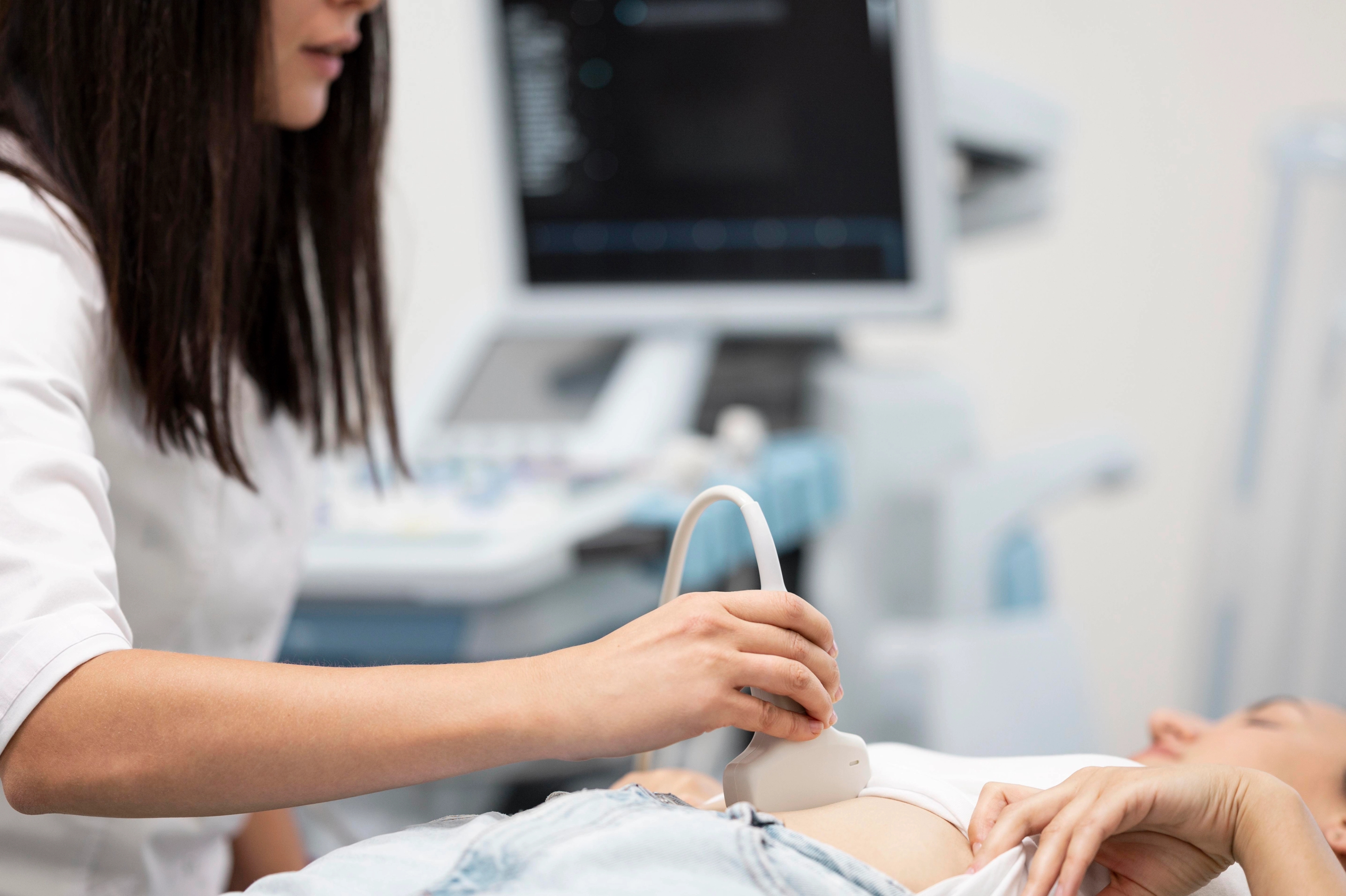
A FibroScan is an ultrasound like test that measures how stiff your liver is. The probe sends a small vibration into the liver and times how fast it travels through. Healthy liver tissue is soft, so the wave moves slowly. Scar tissue is stiff, so the wave moves faster. The machine converts that speed into a number in kilopascals, or kPa. More stiffness means more scarring, which doctors call fibrosis.
The test takes about ten minutes, involves no needles or radiation, and you feel only a light tap. It became the standard way to check for liver scarring because the alternative, a liver biopsy, means a needle through the ribs, a day in the hospital, and a small but real risk of bleeding. A FibroScan can be repeated every year without any of that.
One practical detail that matters more than most people are told: you should not eat for at least three hours before the test. Eating increases blood flow to the liver and can push the stiffness number up by several kPa for a couple of hours. If you had a snack in the waiting room, tell your doctor before anyone acts on the result.
The two numbers on your report
Liver stiffness (kPa). This is the number everyone focuses on. It reflects scarring. The scale runs from about 2 kPa in a completely healthy liver to 75 kPa, the maximum the machine can read.
CAP score (dB/m). Many machines also measure how much fat is in the liver, shown as a CAP score in decibels per meter. Roughly, values under about 240 dB/m suggest little or no fat, and the number climbs as fat increases, up to around 400. The exact cutoffs vary between studies and machines, so this number is best read as low, moderate, or high rather than as a precise grade.
You may also see an IQR/median value, usually shown as a percentage. It tells you how consistent the ten measurements were. Below 30 percent is considered reliable. If yours is higher, the stiffness number may be less trustworthy, and a repeat scan is reasonable.
Reading your kPa number: the rule of five
Liver specialists use a simple framework from the Baveno VII consensus, the international guideline on chronic liver disease, sometimes called the rule of five. It works in steps of 5 kPa, and each step maps roughly onto the fibrosis stages doctors use, from F0 (no scarring) to F4 (cirrhosis).
Under 5 kPa: normal liver. This corresponds to F0, no scarring at all.
5 to 10 kPa: mild to moderate scarring is possible, or there may be none. What this range does tell you with high confidence is that advanced scarring can be ruled out. It covers stages F0 to F2.
10 to 15 kPa: advanced scarring is likely. Doctors call this compensated advanced chronic liver disease, and they usually confirm it with a second test, such as an ELF blood test or MR elastography. It most often corresponds to F3, and sometimes to early F4.
15 to 20 kPa: advanced scarring is highly likely, and cirrhosis is possible. This range sits between F3 and F4.
20 to 25 kPa and above: cirrhosis is likely, and the risk of complications from pressure building up in the liver's blood vessels rises. Above 25 kPa, doctors assume that pressure is present. This is stage F4.
A FibroScan estimates these stages rather than measuring them directly, which is why doctors talk in ranges rather than exact stages.
These cutoffs are for fatty liver disease and similar conditions. If your liver disease has a different cause, like hepatitis C or a bile duct condition, the thresholds shift somewhat.
Why 10 kPa is the line doctors watch
Below 10 kPa, advanced scarring can be confidently ruled out. That is why 10 is the threshold in nearly every guideline. Above it, the picture changes, and the risk rises in steps. A 2025 study in the journal Hepatology followed more than 17,000 people with a FibroScan result over about three years. Death rates climbed with each rule of five category: from about 3.4 per 100 people per year below 10 kPa, to 4.3 in the 15 to 20 range, to 5.5 in the 20 to 25 range, and higher still above 25.
Two things are worth holding onto here. First, those are averages across a large group, not a forecast for you. Second, a reading between 10 and 20 kPa is not a verdict. It is the stage where the liver is still compensated, meaning it is still doing its job, and where the evidence says treatment changes the trajectory the most. That is exactly why this range is where new medicines have been approved and where research is concentrated.
Things that can throw off the number
- Eating within three hours. Can raise stiffness temporarily.
- Active inflammation. If your liver enzymes are very high at the time of the scan, the liver is swollen and reads stiffer than the scarring alone would explain.
- Body size. A thicker chest wall can make the standard probe unreliable. Machines have an XL probe for this, and your report should say which was used.
- Congestion. Heart failure and fluid backing up into the liver can raise the reading.
- Operator and machine. Results are quite reproducible, but small differences between visits, up to 1 or 2 kPa, are normal noise, not progression.
Guidelines consider a change of about 20 percent or more between scans clinically meaningful, or any move across the 10 or 15 kPa lines. A jump from 9.8 to 10.6 is not a trend. A move from 9 to 15 is.
Other tests you might see next to it
FIB-4. A score calculated from your age, two routine liver enzymes, and your platelet count, all from blood tests you have probably already had. Below 1.3 makes advanced scarring unlikely; above 2.67 makes it more likely. Doctors often use it to decide who needs a FibroScan at all.
ELF test. A blood test that measures three proteins involved in scar formation. Scores around 9.8 and above point toward advanced fibrosis. It is often used to confirm a FibroScan in the 10 to 15 kPa gray zone.
MR elastography. An MRI based stiffness measurement, more precise than FibroScan and much more expensive. Used when results conflict or the FibroScan was unreliable.
Can liver scarring go backward?
Partly, yes, and this surprises people. The liver is the only major organ that regenerates, and fibrosis is not a one way street. In a well known study of people with fatty liver disease who were followed with repeat biopsies, those who lost 10 percent or more of their body weight saw scarring regress in 45 percent of cases, and no one in that group got worse. With 7 to 10 percent weight loss, 16 percent regressed and the rest held stable. Below 5 percent, fat improved but scarring mostly did not move.
The honest caveat: in that same study, only about 1 in 10 people managed to lose 10 percent through lifestyle alone and keep it off. That gap between what works and what people can actually sustain is the reason medicines for this disease exist now, and the reason so many are still being tested.
What comes next if you are between 10 and 20 kPa
This is the range where the most has changed in the last two years. Until March 2024, there was no approved medicine for fatty liver disease with scarring at all. Since then two have arrived, both specifically for people with moderate to advanced fibrosis but not yet cirrhosis, roughly the F2 to F3 band that a 10 to 15 kPa reading points to. Resmetirom (Rezdiffra), a daily pill, was first. Semaglutide (Wegovy), a weekly injection already used for weight loss, was approved for the liver in August 2025. Both were approved on an accelerated basis, meaning they improved scarring on biopsy at one year but have not yet proven that they prevent cirrhosis or liver failure over the long run. Studies to show that are underway.
The same range is also where research is most active, because it is the sweet spot: high enough risk that the outcome matters, early enough that it can still be changed. If you have diabetes, this is doubly relevant. A 2025 analysis of US national health data found that among adults with diabetes, significant scarring reached 27 percent and cirrhosis 10 percent, and both are rising even as simple fatty liver becomes slightly less common.
A study built for this exact range
One of the largest liver studies ever run is recruiting people whose FibroScan reads between 10 and 20 kPa. It is called SYNERGY-Outcomes, and it is sponsored by Eli Lilly, the company behind the diabetes and weight loss medicines Mounjaro and Zepbound and one of the largest pharmaceutical companies in the world. The study asks a question the approved medicines have not yet answered: can tirzepatide, or a newer medicine called retatrutide, actually prevent the serious outcomes of liver scarring, such as progression to cirrhosis and its complications, over four years?
Who the study is for. Adults with fatty liver disease and moderate to advanced scarring, meaning liver fat of 8 percent or more and a FibroScan between 10 and 20 kPa. A few other things need to be true:
- a BMI of 25 or higher
- no other liver disease, such as hepatitis or alcohol related liver disease
- no history of fluid in the belly, bleeding veins, or liver related confusion
- stable weight, with no loss of more than 11 pounds in the past three months
- if you have diabetes, type 2 with an A1c of 10 or below (type 1 is not eligible)
How it works. About 4,500 participants are randomly assigned to a study medicine or placebo, given as a weekly injection, and followed for about four years. An optional two year extension follows, in which every participant receives one of the active medicines.
Neither medicine is approved for the liver, which is the point of the study. It is running at sites in Florida, Louisiana, New York, Texas, and Utah. If your numbers fit, you can check your eligibility and apply here; the study team confirms everything, including your FibroScan and ELF score, at a screening visit. Applying commits you to nothing, and every detail is explained during informed consent before you decide.
If you do not match this one
Your kPa number decides a lot about which studies you fit. People below 10 kPa are usually recruited into earlier stage studies and diet or lifestyle research. People above 20 kPa, or with signs of decompensation, have studies of their own, often through cirrhosis programs. You can browse everything currently recruiting for fatty liver disease in the US, filtered by location, in this list of active fatty liver studies. And if you are weighing whether to join any study, our guide to how eligibility criteria work explains why the numbers are so specific.
Common questions about FibroScan results
Can you live a long life with liver fibrosis? Yes, most people do. Fibrosis at stages F1 to F3 is compensated, meaning the liver is still doing its job, and many people stay at the same stage for years or improve. The risk that matters most is progression to cirrhosis and its complications, which is exactly what treatment and monitoring aim to prevent. Your own outlook depends on your stage, the cause, and what happens to your weight, blood sugar, and alcohol intake from here.
What does stage 4 liver fibrosis mean? Stage 4, or F4, is cirrhosis: scarring throughout the liver. On a FibroScan it usually corresponds to readings above about 15 kPa in fatty liver disease. Cirrhosis has two phases. Compensated cirrhosis means the liver still functions and there are often no symptoms; many people live well for years in this phase. Decompensated cirrhosis means complications have appeared, such as fluid in the belly or bleeding veins, and care becomes more urgent.
How often should a FibroScan be repeated? Guidelines generally suggest every 2 to 3 years if the reading was low and risk factors are controlled, and every year if there is significant scarring or diabetes. Your doctor may repeat it sooner after a major change like significant weight loss or starting a new medicine, to see whether it worked.
Is a FibroScan as accurate as a liver biopsy? Not quite, but close enough for most decisions. A biopsy looks at actual tissue, but it samples only about 1/50,000th of the liver and carries a small risk of bleeding. FibroScan is very good at ruling out advanced scarring below 10 kPa and at flagging cirrhosis above 15 to 20 kPa. It is least precise in the 10 to 15 gray zone, which is why doctors confirm those results with a second test.
What is a good FibroScan score? For stiffness, under 7 kPa is reassuring in most people, and under 10 kPa rules out advanced scarring. For the CAP fat score, under about 240 dB/m suggests little or no fat. A "good" result also depends on direction: a reading that has come down since your last scan is good news even if it is not yet in the normal range.