

Pluvicto is a radioactive medicine for advanced prostate cancer that seeks out prostate cancer cells carrying a protein called PSMA, wherever they are in the body, and treats them from the inside. Since 2022 it has gone from a last resort to a treatment approved across metastatic prostate cancer, and many men and their families now hear about it at some point. This guide explains how Pluvicto works, who it is for, what treatment involves, its side effects and how they are managed, the precautions at home after each dose, and what comes next if it stops working.
Exploring options for advanced prostate cancer?
Dozens of US studies are testing new radioligand therapies and combinations for metastatic prostate cancer, including for men whose cancer has grown after Pluvicto. Search studies near you and apply in about 5 minutes.
What is Pluvicto?
Pluvicto (lutetium Lu 177 vipivotide tetraxetan, often called lutetium 177 PSMA or Lu-PSMA) is a type of treatment called radioligand therapy. It has two parts: a molecule that seeks out PSMA, a protein found in large amounts on most prostate cancer cells, and a radioactive particle, lutetium 177, attached to it. After an infusion into a vein, the medicine travels through the bloodstream, attaches to PSMA on cancer cells in the bones, lymph nodes, or organs, and releases radiation that damages them over a short distance, sparing most healthy tissue. It is made by Novartis.
Who is Pluvicto for?
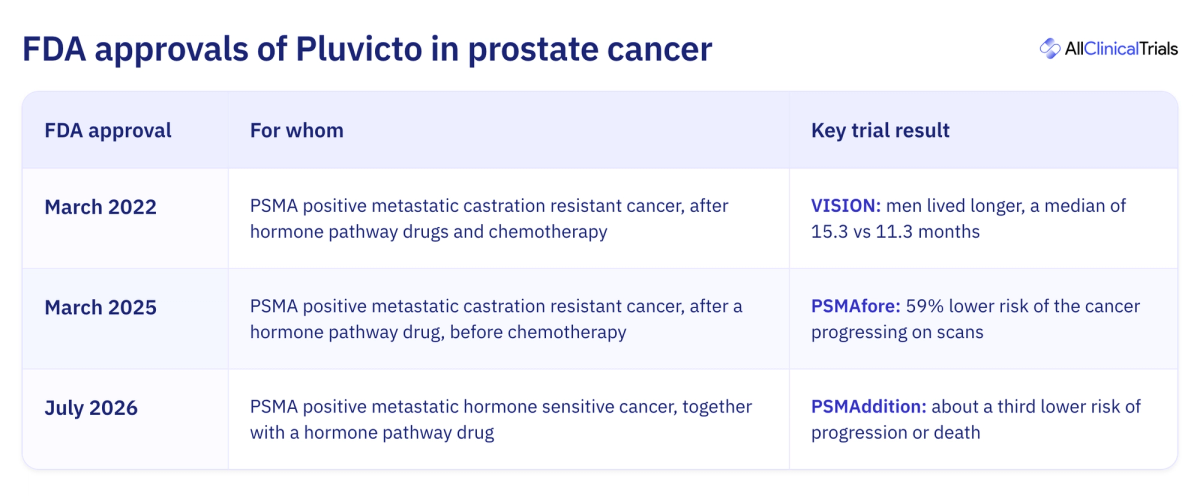
Pluvicto is for men with metastatic prostate cancer whose cancer cells carry enough PSMA. Its approvals have moved steadily earlier in the course of the disease:

Our guide to prostate cancer treatment options explains where these stages fit in the full picture of care.
The PSMA PET scan
Before treatment, you will have a PSMA PET scan, a special scan using a small amount of a radioactive tracer that lights up PSMA. It shows whether your cancer has enough PSMA for Pluvicto to work, and where the cancer is. If the scan shows too little PSMA, Pluvicto is unlikely to help, and other treatments or clinical trials may be better options.
What Pluvicto treatment involves
Pluvicto is given as an infusion into a vein, usually every 6 weeks, for up to 6 doses, in a hospital or clinic with a nuclear medicine department. Each visit usually takes a few hours, and most men go home the same day. Before and during treatment, you will have regular blood tests to check your blood counts and kidney function, and you will be encouraged to drink plenty of fluids and urinate often, which helps clear the radioactive material from your body.
Pluvicto side effects
Most side effects are mild to moderate. In the trial behind the 2025 approval, the most common were:
- Dry mouth, in about 6 in 10 men, because the salivary glands also take up the medicine. It is usually mild; sipping water, sugar-free gum, and mouth moisturizers help, and your care team should know if it affects eating or speaking.
- Tiredness, in about half.
- Nausea, in about a third, usually manageable with anti-nausea medicine.
- Constipation, in about 1 in 5.
When Pluvicto is combined with hormone therapy for hormone sensitive cancer, hot flashes and anemia are also common.
Serious side effects to watch for
Low blood counts. Pluvicto can lower red cells, white cells, and platelets. Tell your care team about unusual tiredness, pale skin, shortness of breath, bleeding or bruising more easily, or signs of infection such as fever, chills, or mouth sores. Doses may be delayed or reduced if counts drop.
Kidney problems. Pluvicto is cleared through the kidneys, which is why kidney function is checked and why staying well hydrated matters. Report passing less urine than usual or swelling in the legs.
Fertility. The radiation can affect sperm production and may cause infertility. If having children matters to you, ask about sperm banking before treatment.
Radiation safety at home after each dose
For several days after each dose, your body gives off a small amount of radiation, and some leaves the body in urine. Your care team will give you specific instructions, which usually include keeping some distance from other people, especially children and pregnant women, for a set number of days; sleeping in a separate bed for a period; sitting to urinate, flushing the toilet, and washing your hands well; and avoiding sexual activity for a short time and using contraception for a period after treatment. These steps protect the people around you, and they are temporary.
How well does Pluvicto work?
In the VISION trial, men with castration resistant cancer who had already had hormone drugs and chemotherapy lived longer when Pluvicto was added to standard care, a median of 15.3 months compared with 11.3 months. Earlier in the disease, Pluvicto has mainly been shown to delay the cancer growing: in PSMAfore, it cut the risk of progression on scans by 59 percent compared with switching to another hormone drug, and in PSMAddition, adding it to standard treatment for hormone sensitive cancer lowered the risk of progression or death by 28 percent. It is not yet known whether it helps men with hormone sensitive cancer live longer, because those results are still being collected. Results vary from man to man, and PSA levels and scans are used to see how well it is working for you.
When Pluvicto stops working
For many men, prostate cancer eventually finds a way around each treatment, including Pluvicto. What comes next depends on the treatments you have already had and on your cancer’s biology: options may include chemotherapy, other hormone pathway drugs, PARP inhibitors for men with BRCA or related mutations, or clinical trials.
Radioligand therapy is one of the fastest growing areas of prostate cancer research. More than 60 studies recruiting in the US involve radioligand or lutetium-based treatments for prostate cancer, testing new targets, combinations with other medicines, ways to make cancer cells carry more PSMA, and stronger radioactive particles such as alpha emitters, which some studies offer to men whose cancer has grown after Pluvicto. Most cancer trials give participants either the new treatment or the current standard one; our guide explains when placebos are and are not used. Our prostate cancer clinical trials page lists studies recruiting now, and nothing is decided until you have gone through informed consent.
Three things to have ready: your disease state (hormone sensitive or castration resistant), the treatments you have had and when, and your most recent PSA, PSMA PET, and genetic test results.
Questions to ask your care team
Am I a candidate for Pluvicto, and has my PSMA PET scan shown enough PSMA? Where will I receive it, and how long is each visit? What radiation precautions should I follow at home, and for how long? How will we know if it is working? What are my options if it stops working, and are there clinical trials I could join?
Common questions
What is Pluvicto used for? For men with PSMA positive metastatic prostate cancer, both castration resistant and, since July 2026, hormone sensitive cancer in combination with a hormone pathway drug.
How is Pluvicto given? As an infusion into a vein, usually every 6 weeks for up to 6 doses, at a hospital or clinic with nuclear medicine facilities.
What are the side effects of Pluvicto? The most common are dry mouth, tiredness, nausea, and constipation. It can also lower blood counts, affect the kidneys, and cause infertility, so blood tests are checked regularly.
How long does dry mouth last after Pluvicto? It varies. For many men it is mild and improves after treatment ends, but it can last longer in some. Tell your care team if it affects eating, speaking, or sleep.
Am I radioactive after Pluvicto? For a few days after each dose, you give off a small amount of radiation, so your care team will ask you to follow temporary precautions, especially around children and pregnant women.
Is Pluvicto chemotherapy? No. It is radioligand therapy: a targeted medicine that delivers radiation directly to cancer cells that carry PSMA.
Do prostate cancer trial participants get paid? Some studies offer compensation for time and travel, and study related care is typically provided at no cost to participants. Compensation varies by trial and is always described during the informed consent process before you agree to anything.