

Every year, people apply to clinical trials hoping to try a new treatment or help research move forward. But patient interest is not spread evenly across conditions, and neither are the studies looking for them. We compared a full year of patient applications on AllClinicalTrials.com with the studies recruiting on the platform, condition by condition. In some areas, patient demand far outpaces the studies available. In others, studies are plentiful but applications are comparatively few, and the reasons may surprise you.
Ready to find a clinical trial?
Search recruiting studies near you, check the basic criteria, and apply in about 5 minutes. If your condition has few open studies, try related conditions or widen your search area.
What we measured
For each condition, we compared two things. The first is demand: the patient applications submitted on AllClinicalTrials.com between November 1, 2025 and October 31, 2026. The second is supply: the studies on the platform that were actively recruiting at the end of October 2026. From these we calculated how many applications each open study received on average, and then compared every condition with the platform-wide average, calculated the same way across all conditions. A condition at 1.0 times the average has a typical balance; a condition at 10 times the average has ten times as many applications per open study as the average.
To keep the comparison fair, conditions were grouped using MeSH, the standard medical vocabulary used by the US National Library of Medicine, rather than the many different ways conditions are written in study listings. Each condition is counted separately, so a study that covers both obesity and overweight appears in both. We focused on the conditions that received the most applications, and left out broad categories such as "mental disorders" as well as conditions where applications went to fewer than ten studies, since a single popular study would distort the picture. Because one person can apply to more than one study, the figures describe applications, not individual patients. The analysis uses only aggregated figures and no personal information.
Where patient demand outpaces studies
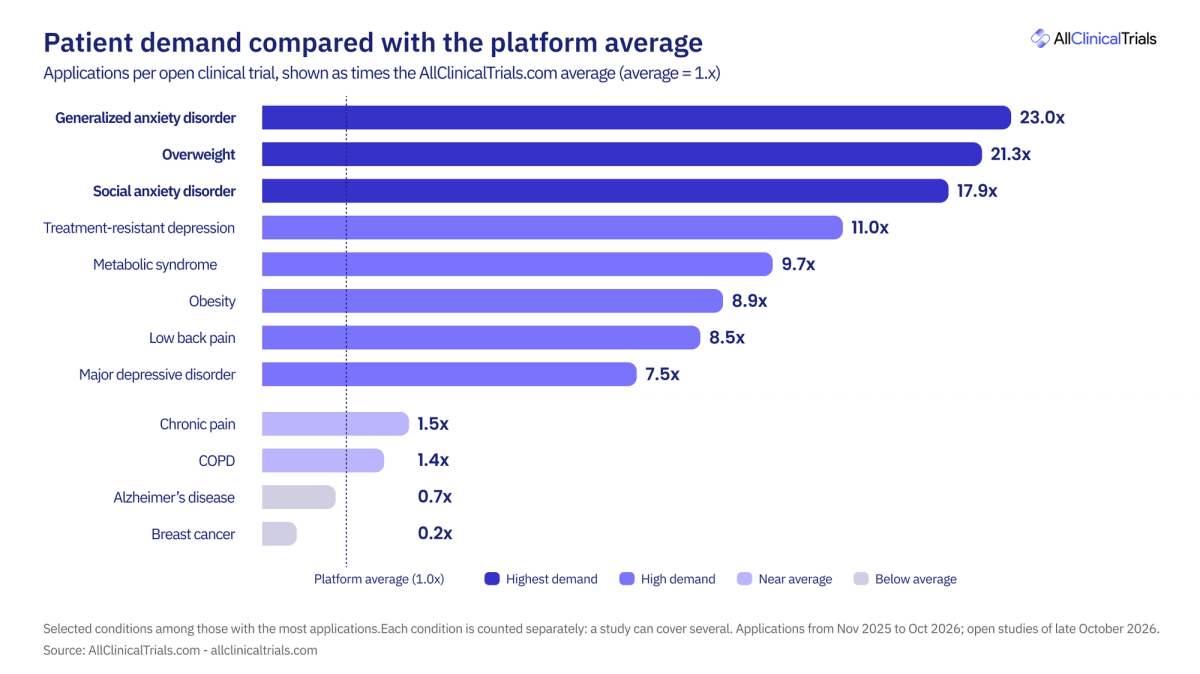
Applications per open study for selected conditions, shown as times the platform average.
The largest gaps were in mental health. Studies for generalized anxiety disorder drew 23 times the platform average in applications per open study. The condition accounted for 2.7% of all applications on the platform, but only about 0.1% of the studies recruiting. Social anxiety disorder was close behind at nearly 18 times the average, and treatment-resistant depression at 11 times. Even major depressive disorder, with many more studies available, stood at 7.5 times the average. Together, the pattern suggests that many people living with anxiety and depression are actively looking for new options, while comparatively few studies are looking for them. Our anxiety, depression, and mental health pages list the studies recruiting now.
Weight and metabolic health formed the second cluster. Studies listed under overweight drew 21 times the average, metabolic syndrome nearly 10 times, and obesity almost 9 times. Obesity also stood out for sheer scale: about one in six of all applications on the platform went to obesity studies, which make up less than 2% of the studies recruiting, likely reflecting the strong interest in new weight loss medicines. Low back pain rounded out the top group at 8.5 times the average. See our obesity and back pain pages for current studies.
Where studies are plentiful but applications are fewer
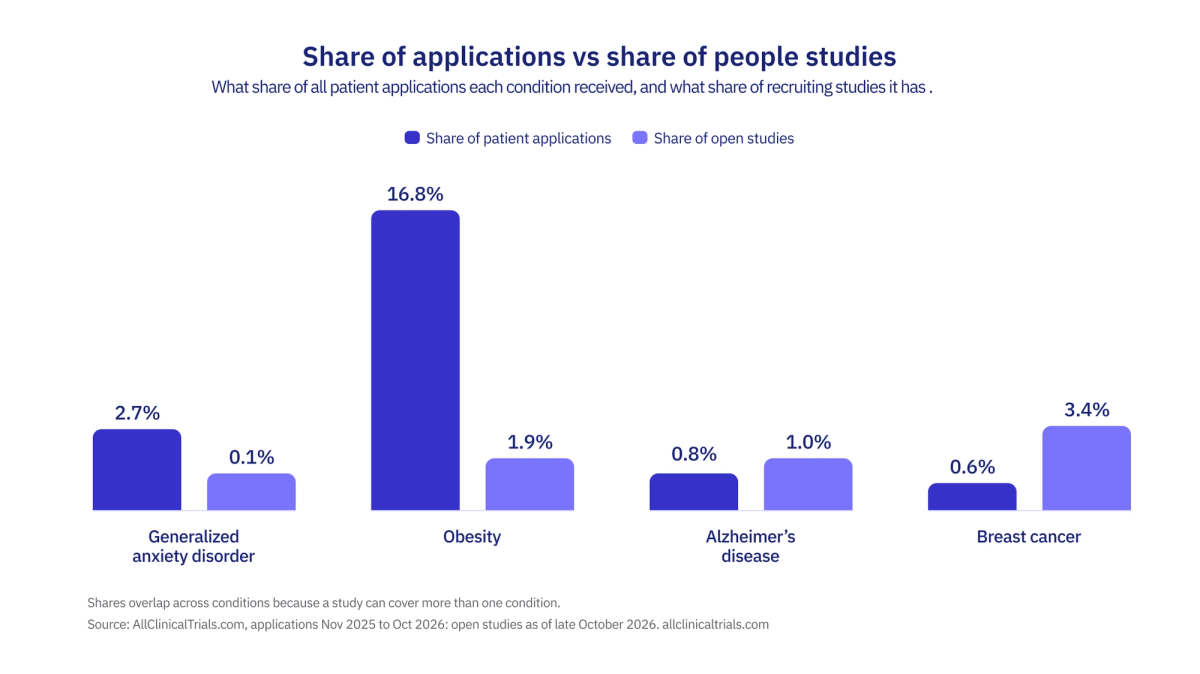
Some conditions draw a far larger share of applications than their share of open studies, and others the reverse.
At the other end of the scale, some conditions drew far fewer applications per study. Breast cancer stood out: it accounted for 3.4% of recruiting studies but only 0.6% of applications, about one-fifth of the average per study, and it was the only condition in our analysis with more open studies than applications over the year. Alzheimer's disease was also below average, at 0.7 times, while COPD and chronic pain were only slightly above it, at about 1.4 and 1.5 times, far below the conditions at the top of the list.
That does not mean people with these conditions are not interested in research. Cancer patients, for example, may be referred to studies directly by their oncologist and never need to search for a trial online. Alzheimer's studies often require a study partner and specific test results, which can make the first step harder for families to take on their own. But it suggests that for these conditions, the limiting factor may be less the number of studies and more whether patients learn about them and can reach them. For someone with breast cancer, Alzheimer's disease, or COPD, there may be more options than they realize; see our breast cancer, Alzheimer's disease, and COPD pages.
Why these gaps may exist
These figures describe patterns, not causes, but several explanations are possible. Research activity does not always follow patient interest: on our platform, recruiting studies for breast cancer alone outnumber those for all anxiety disorders combined by more than two to one. How patients find studies may matter too. People with common conditions such as anxiety, depression, or excess weight often search for help online and may come across studies on their own, while people with cancer or dementia may be more likely to find their way into research through their specialists, outside any online platform.
What this means for patients
If you live with one of the high demand conditions, you are not alone in looking, and some studies may fill quickly. It helps to apply to more than one study, to look at related conditions as well as your main diagnosis, and to check eligibility carefully before applying so your application goes where it has the best chance. If your condition has many open studies, the opposite applies: there may be more options than you expect, and it is worth asking your doctor or searching beyond the first few results. Our guides explain how to volunteer for a clinical trial, how eligibility criteria work, and what to know before participating. And if you want to help research without a specific condition, many studies also need healthy volunteers.
What this means for research
For sponsors and study teams, the numbers point to untapped willingness. In areas like anxiety disorders and treatment-resistant depression, motivated patients are already looking for studies, which can shorten recruitment for teams that open studies there. In areas with many studies and fewer applicants, the bigger opportunity may be in reaching patients, through clearer listings, more responsive study teams, and closer work with the doctors who treat them.
What these numbers can and cannot tell us
This analysis reflects activity on one platform, AllClinicalTrials.com, and patients who apply through it may not represent everyone with a given condition. Demand can be influenced by how visible certain studies were on the platform during the year, and supply is a snapshot of studies recruiting at the end of October 2026, while applications cover the full twelve months. Because studies often list more than one condition, the figures for individual conditions overlap and should not be added together. Finally, an application shows interest, not enrollment: not everyone who applies is eligible or ends up taking part.
About this analysis
This analysis was conducted by AllClinicalTrials.com, a platform that helps patients find and apply to clinical trials, using aggregated figures on applications and recruiting studies on the platform. No personal information about applicants was used or published. Because we operate a trial search platform, we have an interest in how patients find and reach studies; we describe the method in full so others can judge the results.
Frequently asked questions
Which conditions had the highest demand compared with open studies? Generalized anxiety disorder, at 23 times the platform average, followed by overweight (21 times) and social anxiety disorder (nearly 18 times).
Which conditions drew the fewest applications per open study? Breast cancer, which made up 3.4% of recruiting studies but only 0.6% of applications, and Alzheimer's disease, at 0.7 times the platform average. Breast cancer was the only condition in our analysis with more open studies than applications over the year.
Does high demand mean it is harder to get into a study? Not necessarily, since many applicants do not meet a study's criteria. But in high demand areas, some studies may fill quickly, so it helps to apply to more than one and to check eligibility carefully.
How was the analysis done? We compared patient applications on AllClinicalTrials.com from November 1, 2025 to October 31, 2026 with studies recruiting on the platform at the end of October 2026, grouping conditions with the standard MeSH medical vocabulary, and expressed each condition relative to the platform average. Only aggregated figures were used.