

If your blood test or biopsy report says “ESR1 mutation detected,” you are not alone, and it does not mean your options have run out. ESR1 mutations are one of the most common ways hormone receptor positive breast cancer learns to resist standard hormone therapy. The good news is that this is now one of the fastest moving areas of breast cancer care: since 2023, the FDA has approved several medicines designed specifically for cancers with this mutation. This guide explains what an ESR1 mutation is, how it is found, what it means for your treatment and outlook, and which clinical trials are looking for people like you.
Found an ESR1 mutation on your test?
Many studies are testing new hormone therapies and combinations for hormone receptor positive metastatic breast cancer, including for people with ESR1 mutations. Search studies near you and apply in about 5 minutes.
What is an ESR1 mutation?
ESR1 is the gene that carries the instructions for the estrogen receptor, the switch on breast cancer cells that estrogen turns on to make them grow. In hormone receptor positive breast cancer, most treatment works by cutting off that signal: aromatase inhibitors such as letrozole, anastrozole, and exemestane lower estrogen levels, while tamoxifen and fulvestrant block or remove the receptor itself.
An ESR1 mutation changes the receptor so that it can stay switched on even when there is very little estrogen around. That is why aromatase inhibitors stop working well against cancers with this mutation, and why older receptor blockers may work less well too. Newer medicines called oral SERDs, which attach to the receptor and break it down, were developed to work despite the mutation.
How common is an ESR1 mutation?
ESR1 mutations are rare when breast cancer is first diagnosed, found in about 1 percent of early tumors. They become much more common after treatment: in metastatic hormone receptor positive breast cancer that has been treated with an aromatase inhibitor, studies find them in about a third of people or more, and some report even higher rates. In other words, they usually develop during treatment, as the cancer adapts to low estrogen.
Is an ESR1 mutation inherited?
No. An ESR1 mutation develops in the cancer cells during treatment. It is not passed down in families and is not something your children or relatives need to be tested for, unlike inherited mutations such as BRCA1 and BRCA2.
How is an ESR1 mutation found?
ESR1 mutations are most often found with a blood test called a liquid biopsy, which looks for small pieces of tumor DNA circulating in the blood, known as circulating tumor DNA or ctDNA. The FDA approved the Guardant360 CDx blood test as a companion test for the ESR1 medicines, and tumor tissue can also be tested. Blood testing is often preferred, because it reflects the cancer as it is now, while an older biopsy may have been taken before the mutation appeared.
Because ESR1 mutations develop over time, a negative result does not mean you will never have one. Doctors often repeat the test when the cancer grows, and in some cases during first treatment, since one newer approach now changes treatment as soon as the mutation appears in the blood. Similar blood tests are also used in other situations, such as Signatera, which looks for signs of recurrence after early breast cancer treatment.
What an ESR1 mutation means for your treatment
The first treatment for metastatic hormone receptor positive, HER2 negative breast cancer is usually hormone therapy plus a CDK4/6 inhibitor such as Kisqali, Verzenio, or Ibrance. When that stops working, doctors test the cancer for mutations, and an ESR1 result points toward a group of medicines made for exactly this situation.
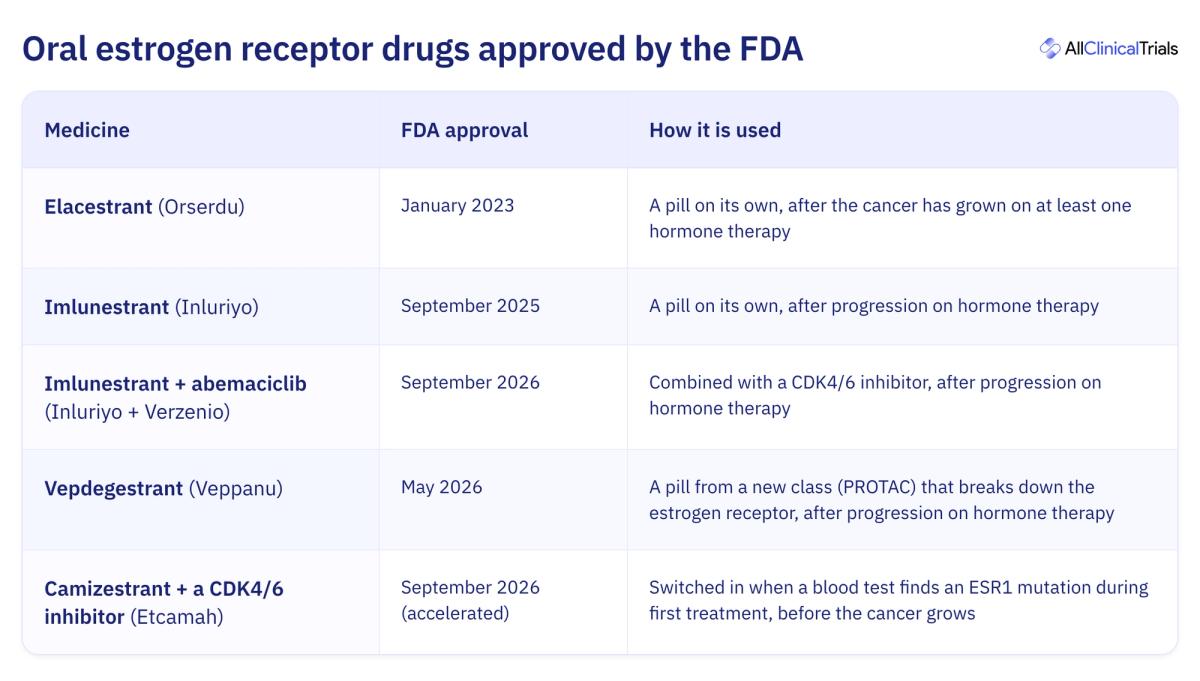
Your oncologist will also look at other test results. Many cancers have more than one change; for example, a PIK3CA, AKT1, or PTEN mutation can point toward other targeted pills, and the order in which treatments are used depends on your previous treatments, side effects, and how quickly the cancer has been growing.

Our guide to breast cancer treatment options explains how these choices fit together.
Many hormone receptor positive cancers are also HER2 low, and for them an antibody drug conjugate such as Enhertu is another option at this stage; our guide covers Enhertu side effects.
How well do these medicines work?
Results vary from person to person. In the trial behind the first approval, elacestrant roughly doubled the time before the cancer progressed compared with standard hormone therapy in people with ESR1 mutations, from a median of 1.9 to 3.8 months, with some people responding for much longer. In the trial behind the September 2026 approval, imlunestrant combined with abemaciclib kept the cancer from progressing for a median of 11.1 months, compared with 5.5 months for imlunestrant alone. In the elacestrant trial, people who had been on hormone therapy with a CDK4/6 inhibitor for at least a year before tended to do better.
ESR1 mutation and life expectancy
An ESR1 mutation tells you that your cancer has found a way around aromatase inhibitors. It does not, on its own, tell you how long you will live. Metastatic hormone receptor positive breast cancer is not curable today, but many people live for years with it, moving from one treatment to the next, and the number of options for ESR1 mutated cancer has grown quickly since 2023. Your outlook depends on many things, including where the cancer has spread, how it has responded so far, your other test results, and your overall health. Your oncologist is the best person to talk this through with.
Clinical trials for ESR1 mutated breast cancer
Because ESR1 mutations appear at a specific point in treatment, many clinical trials enroll people at exactly this step. Dozens of studies recruiting in the US include people with ESR1 mutations, testing next generation oral SERDs, new combinations with CDK4/6 inhibitors and other targeted medicines, and other new ways to block or break down the estrogen receptor. Some trials enroll people as soon as the mutation is detected; others after the cancer has grown on a CDK4/6 inhibitor.
Most breast cancer trials compare a new treatment with the current standard one, or add it on top, so taking part does not mean going without treatment; our guide explains when placebos are and are not used. Our metastatic breast cancer clinical trials page lists studies recruiting now. The application takes about 5 minutes, and nothing is decided until you have gone through informed consent.
Three things to have ready: your cancer type (for example, hormone receptor positive, HER2 negative), the treatments you have had and when, and your mutation results, including ESR1 and any others such as PIK3CA.
Questions to ask your oncologist
Has my cancer been tested for ESR1, and should the test be repeated? Which ESR1 medicines are options for me, and in what order? Do I have any other mutations that matter for treatment? How will we know if the new treatment is working? Are there clinical trials I could join now, or after this treatment?
Common questions
What does it mean to have an ESR1 mutation? It means the estrogen receptor in your cancer cells has changed so it can stay active even with very little estrogen. This usually makes aromatase inhibitors less effective, but several newer medicines are designed to work against it.
How is an ESR1 mutation tested? Usually with a blood test (liquid biopsy) that looks for tumor DNA in the blood. Tumor tissue can also be tested. The test is often repeated over time, because the mutation can appear during treatment.
What is the treatment for an ESR1 mutation? Medicines approved specifically for ESR1 mutated, hormone receptor positive, HER2 negative advanced breast cancer include elacestrant, imlunestrant (alone or with abemaciclib), vepdegestrant, and camizestrant with a CDK4/6 inhibitor. The best choice depends on your previous treatment and other test results.
Is an ESR1 mutation hereditary? No. It develops in the cancer during treatment and is not passed down in families.
What is the life expectancy with an ESR1 mutation? There is no single answer. The mutation signals resistance to aromatase inhibitors, but many people live for years with metastatic hormone receptor positive breast cancer, and new treatment options for ESR1 mutated cancer keep arriving. Your oncologist can explain what it means for you.
Can I join a clinical trial with an ESR1 mutation? Yes, many trials enroll people with ESR1 mutations, some as soon as the mutation is found and others after the cancer has grown on earlier treatment. Each study lists its own rules.
Do breast cancer trial participants get paid? Some studies offer compensation for time and travel, and study related care is typically provided at no cost to participants. Compensation varies by trial and is always described during the informed consent process before you agree to anything.