

RDW is one of the many abbreviations on a complete blood count, and it is often flagged without any explanation. It stands for red cell distribution width, and it describes how much your red blood cells vary in size. A high RDW is not a diagnosis on its own; it is a clue that something, most often a shortage of iron, vitamin B12, or folate, is affecting how your body makes red blood cells. The real meaning comes from reading it together with your other results. This guide explains what RDW measures, what the normal range is, how to read it with MCV, the most common causes of a high RDW, and when it is worth a closer look.
Diagnosed with kidney disease and not on dialysis?
Clinical studies are testing new treatments that may help slow kidney disease.
What RDW measures
Healthy red blood cells are fairly uniform in size. RDW measures how much they vary: the more mixed the sizes, the higher the number. Doctors call that variation anisocytosis. When your bone marrow is short of something it needs to build red cells, such as iron or vitamin B12, it starts releasing cells of uneven sizes, and RDW rises, sometimes before other values on the blood count change. That makes RDW a useful early warning sign.
What is a normal RDW?
For most adults, a normal RDW is roughly 11.5 to 14.5 percent, though labs use slightly different ranges, such as 12 to 15 percent, so always compare your result with the range printed on your report. Some reports also show RDW-SD, a different way of measuring the same thing in femtoliters. A low RDW is not linked to any recognized condition; uniform red cells are what a healthy marrow produces.
How to read RDW with MCV
RDW makes the most sense next to MCV, the mean corpuscular volume, which tells you the average size of your red cells. Together they point toward the likely cause:
High RDW and low MCV: small cells of mixed sizes, the classic pattern of iron deficiency.
High RDW and high MCV: large cells of mixed sizes, the typical pattern of vitamin B12 or folate deficiency.
High RDW and normal MCV: often an early deficiency, a mix of deficiencies (for example iron and B12 together), recent blood loss, or a recovering marrow after treatment.
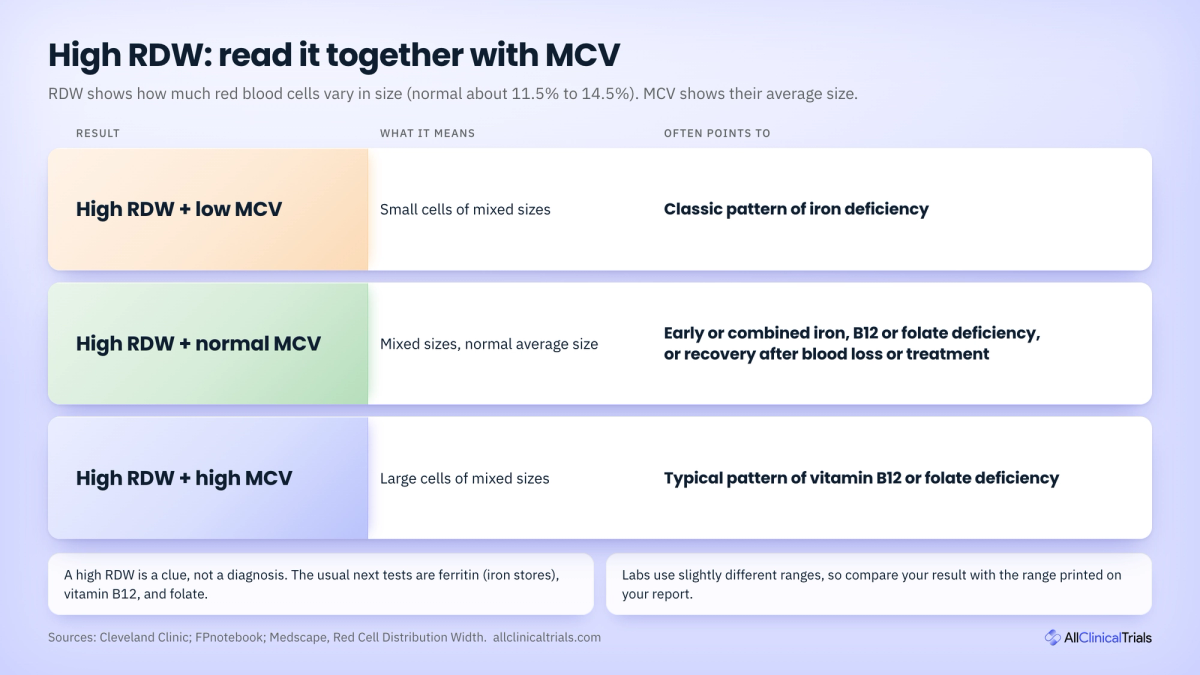
How RDW and MCV together point to the likely cause. Labs use slightly different ranges.
Hemoglobin adds the last piece: if it is low, you have anemia, and RDW helps narrow down which kind. Our anemia page covers the condition in more detail.
Common causes of a high RDW
Iron deficiency. The most common cause, often from heavy periods, low dietary iron, pregnancy, or slow blood loss from the gut. Conditions that affect absorption, such as celiac disease and Crohn's disease, can contribute.
Vitamin B12 or folate deficiency. From diet, absorption problems, or certain medicines, including long term metformin and acid reducing drugs.
Recent bleeding or a blood transfusion. Both mix new and older cells of different sizes.
Chronic conditions. Chronic kidney disease, liver disease, thyroid problems, and chronic inflammation can all raise RDW. In kidney disease, RDW tends to rise as the disease progresses.
Bone marrow conditions. Less commonly, conditions such as myelodysplastic syndromes change how red cells are made.
Why RDW matters beyond anemia
Research over the past two decades has found that a high RDW is linked with a higher risk of complications in several conditions, including heart failure, heart attack, and chronic kidney disease, even when there is no anemia. Doctors do not use RDW alone to make decisions, but it is one reason a persistently high result is worth following up rather than ignoring.
What to do with a high RDW
Look at your MCV and hemoglobin, and ask your doctor whether iron studies (ferritin), vitamin B12, and folate levels should be checked, since these are the usual next tests. Treating the cause, such as replacing iron or B12, brings RDW back toward normal over a few months as new, uniform cells replace the old ones. If your high RDW comes with known kidney, liver, or heart disease, it is worth discussing as part of managing that condition.
When a blood test leads to research
Many of the conditions behind a persistently high RDW are areas where new treatments are being tested. Chronic kidney disease caught before dialysis is one of the most active, and heart failure is another, with studies enrolling adults already taking medicine for their heart. If your blood tests are part of managing one of these conditions, a clinical trial may be worth considering. Studies for heart conditions include a group of studies for adults with heart failure and other heart conditions.
How to find a study
AllClinicalTrials.com lists studies recruiting across the US and Canada for kidney disease, heart disease, anemia, and many other conditions, and you can filter by location. Right now that includes a group of studies for adults with chronic kidney disease or protein in the urine who are not on dialysis. The application takes about 5 minutes, and nothing is decided until you have gone through informed consent.
Common questions
What does a high RDW mean? That your red blood cells vary more in size than usual. Most often it points to iron, vitamin B12, or folate deficiency, but recent bleeding and chronic conditions can also raise it.
What is a normal RDW range? Roughly 11.5 to 14.5 percent for most adults, though some labs use 12 to 15 percent. Use the range on your own report.
Is a high RDW serious? On its own it is a clue rather than a diagnosis. It becomes more meaningful with other results, such as low hemoglobin, or alongside known kidney, liver, or heart disease.
What does high RDW with low MCV mean? Small red cells of mixed sizes, the classic pattern of iron deficiency. Iron studies are the usual next step.
What does high RDW with high MCV mean? Large red cells of mixed sizes, which typically suggests vitamin B12 or folate deficiency.
Can a high RDW be normal? A slightly high result can be temporary, for example after recent bleeding or while recovering from a deficiency. Your doctor may repeat the test.
Is a low RDW a problem? No recognized condition is linked to a low RDW. It means your red cells are uniform in size.
Do clinical trial participants get paid? Some studies offer compensation for time and travel, and study related care is typically provided at no cost to participants. Compensation varies by trial and is always described during the informed consent process before you agree to anything.