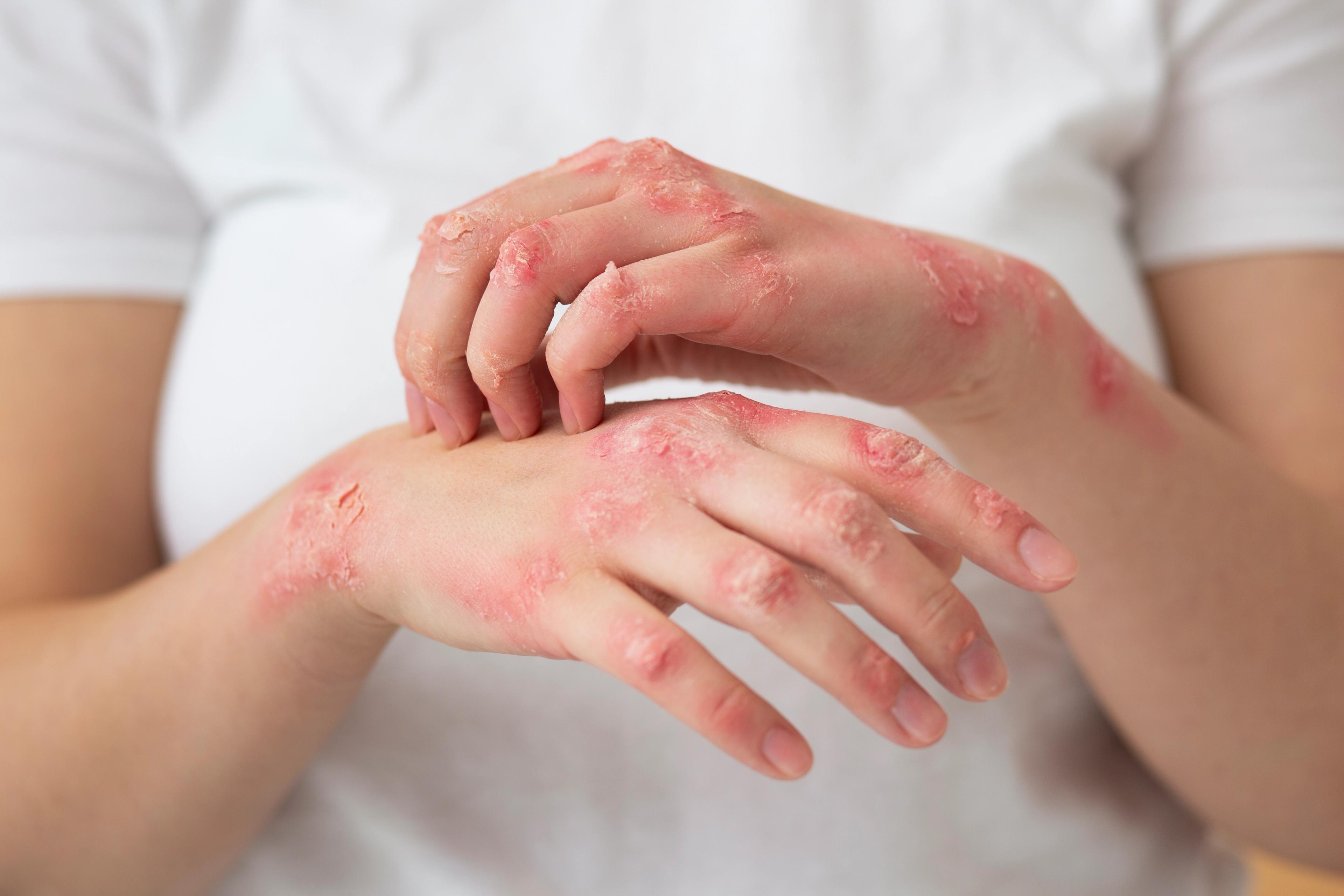

Psoriasis has a strange problem. It is not that there are too few treatments. It is that there are so many that most people have no idea what actually exists or what might come next. And there is still no cure. Plaques come back, medicines that worked can stop working, and about 3 in 10 people with psoriasis develop psoriatic arthritis on top of the skin disease. So it helps to see the whole map at once: what is approved in the US today, what researchers are testing right now, and how psoriasis differs depending on which type you have and where it lands.
Looking for treatment options for Psoriasis?
Browse open Psoriasis clinical trials near you! We'll handle the follow-up.
What is approved today
The US list for plaque psoriasis is long, so it makes sense to group it by how the medicines are taken. A quick reminder first: psoriasis is an immune-mediated disease. An overactive immune response, running mainly through pathways called IL-23 and IL-17, makes skin cells multiply far faster than normal, and almost every modern psoriasis drug works by quieting some part of that response. None of this is treatment advice. What fits you is a conversation with your dermatologist.
Creams and ointments. Topicals are the oldest layer of psoriasis care. The newer entries are tapinarof and roflumilast, both approved in 2022, and they matter because they are nonsteroidal, so they avoid the problems of long term steroid cream use.
Older pills. Methotrexate, cyclosporine, and acitretin have been used for decades. They calm the immune system or slow skin cell growth in a broad, less targeted way.
Biologics. Injectable medicines that block one specific immune signal. Twelve are approved for plaque psoriasis, in families by target. Four block TNF, an inflammation signal: etanercept, infliximab, adalimumab, and certolizumab pegol. Ustekinumab blocks IL-12 and IL-23 together. Four block IL-17: secukinumab, ixekizumab, brodalumab, and bimekizumab, approved in October 2023 as the first to block both the IL-17A and IL-17F forms of the signal. And three block IL-23 directly: guselkumab, tildrakizumab, and risankizumab.
Newer targeted pills. Apremilast came first, then deucravacitinib in 2022, a pill that works on an immune enzyme called TYK2. The newest is icotrokinra, approved in 2026. It is the first oral peptide that blocks the IL-23 receptor, which means it goes after the same pathway as the strongest injectables but comes as a once a day pill.
What researchers are testing now
The pipeline is where psoriasis gets genuinely interesting, because the field has raised its own bar. Here is some of what is in motion.
The new oral generation. Icotrokinra's approval came out of four Phase 3 studies with about 2,500 people, and the numbers explain the buzz: about two-thirds reached clear or almost clear skin by week 16, and just under half reached almost complete clearance, with side effect rates within about a percentage point of placebo. What made those studies unusual is that they ran head to head against an approved pill, not just against placebo. Takeda is chasing the same territory with zasocitinib, an oral TYK2 blocker that reported positive Phase 3 results, including more complete skin clearance than deucravacitinib in a direct comparison.
Next wave biologics. Companies are still trying to out-do the current injectables. Oruka Therapeutics is running an open label extension study of its anti IL-23 antibody ORKA-001, a Phase 2 study enrolling 240 people with plaque psoriasis who continue on the drug after an earlier study ends. Extensions like this are how a field learns what happens over years rather than over 16 weeks.
Psoriasis plus its companions. Eli Lilly is running a 200 person Phase 4 study of tirzepatide with ixekizumab in people who have both plaque psoriasis and obesity, testing whether treating the metabolic side helps the skin side. And the PAMPA study run by NYU Langone Health, a Phase 4 trial with 176 participants, is asking one of the field's biggest questions: can treating psoriasis early prevent psoriatic arthritis from developing at all?
Why new psoriasis drugs still take years
Psoriasis studies are actually faster and cleaner than studies in most diseases. Skin clearance is easy to see and measure, and unlike many conditions, people on placebo rarely clear up on their own, so results read out clearly. Still, real obstacles remain.
The comparison problem. The field is so crowded that a new drug can no longer just beat placebo. Regulators, doctors, and sponsors expect it to beat an approved medicine in a head to head study. That is a much higher bar, and it needs more participants.
The representation problem. People with darker skin are underrepresented in psoriasis studies, and that gap matters, because psoriasis often looks violet or gray on darker skin rather than red and gets missed more often. Prevalence is reported at 3.6 percent in White Americans versus 1.5 percent in African Americans, and researchers believe part of that difference is underdiagnosis. Sponsors want more diverse study groups, and why that representation matters so much is worth understanding on its own.
The prevention question. About 3 in 10 people with psoriasis develop psoriatic arthritis, and nobody yet knows whether early treatment can stop that. Answering it takes studies that follow people for years.
Psoriasis affects more than skin
This part gets skipped in a lot of patient guides, and it should not be. Beyond the roughly 3 in 10 risk of psoriatic arthritis, research links psoriasis to higher rates of cardiovascular disease, heart attack, stroke, metabolic syndrome, obesity, and depression. A 2007 study found that severe psoriasis carried about a 50 percent higher risk of death compared with people without the disease, driven largely by cardiovascular causes, while mild psoriasis showed no such increase. These are population level findings, not predictions about any one person. But they are a good reason to talk with your doctor about heart health, weight, and mood, not only about skin. Researchers take that side seriously too: UCSF is enrolling 120 people in a study of audio based therapy for anxiety in psoriasis.
The types of psoriasis, and how they differ
Plaque psoriasis is about 80 to 90 percent of psoriasis, the thick scaly patch most people picture, and nearly every drug study recruits for it, so the approved list above is really the plaque psoriasis list. Guttate psoriasis is about 8 percent, many small drop-like spots with finer scale, often triggered by strep throat, and it can clear up on its own, though in some people it later turns into plaque psoriasis. Inverse psoriasis affects 21 to 30 percent and sits in skin folds, where it stays moist and looks smooth and shiny instead of scaly, which is why it gets mistaken for a fungal infection. Pustular psoriasis is about 3 percent, painful white pus-filled bumps, and erythrodermic psoriasis is rare, roughly 2 percent, but it is the one emergency here, it can be life-threatening, and a flare needs a health care provider right away.
Location matters as much as type. Up to two thirds have genital psoriasis at some point, about half get it on the face, and 12 to 16 percent get it on the palms and soles.
Is nail psoriasis the same as nail fungus?
No, but they look alike. About half of people with psoriasis have nail involvement at any given time, and an estimated 9 in 10 will at some point. It causes pitting, thickening, deformed nails, discoloration, and nails lifting away from the nail bed, which is close to the picture fungus makes, so it gets mistaken for an infection. A clinician may test a nail sample before deciding, and the two can occur together in the same person.
What is the difference between scalp psoriasis and dandruff?
At least half of people with plaque psoriasis get at least one scalp flare, so this comes up a lot. Scalp psoriasis scale looks powdery with a silvery sheen, while dandruff and seborrheic dermatitis look yellowish and greasy. Psoriasis scale is thicker and drier, it often extends past the hairline onto the forehead, neck, or behind the ears, it usually comes with psoriasis elsewhere on the body, and it tends to be more persistent and harder to treat.
The cause is the same faulty immune signaling as psoriasis anywhere else. Not hygiene, not the wrong shampoo. And there is no cure for scalp psoriasis, though there are more effective treatments today than there have ever been.
Which type you have shapes how it is managed and which studies you might fit.
Myths worth clearing up
"Psoriasis is contagious."
It is not. You cannot catch it from touching someone, sharing towels, or swimming in the same pool. It comes from a person's own immune system.
"It is just a skin problem."
Psoriasis is an immune-mediated disease of the whole body. The joint, heart, and metabolic links above are why doctors treat it as more than a cosmetic issue.
"It looks the same on everyone."
On darker skin, plaques often look violet, gray, or brown instead of red, which is one reason psoriasis is underdiagnosed in people of color.
"Psoriasis is just bad eczema."
Different diseases, confused in both directions. Psoriasis makes well-defined thick scaly patches, commonly on the elbows and knees, while eczema tends to appear in the crooks of the knees and elbows. Psoriasis itch tends to be milder, and eczema can itch intensely. One Australian study found most children with psoriasis were first diagnosed with something else, often eczema.
"You brought it on yourself."
Psoriasis runs strongly in families. In a Danish study of 10,725 twin pairs, genes explained about 68 percent of who develops it: about 4 in 100 get psoriasis with no affected parent, 14 to 28 in 100 with one, and 40 to 65 in 100 when both parents have it.
Mild, moderate, severe: what the labels mean
Psoriasis has no numbered stages. Doctors rate it by extent and intensity instead, using two main tools. BSA estimates how much of the body's surface is affected. PASI combines the affected area with plaque redness, thickness, and scaling.
Care usually escalates with severity, from topicals toward systemic medicines, and the exact path is something each person works out with their dermatologist. Knowing roughly where you sit is still useful, because most drug studies recruit people rated moderate to severe, and results are reported in the same language, so a PASI 90 result means 90 percent improvement from where a person started.
How to find a psoriasis study
Psoriasis studies are recruiting across the US right now, from big pharma drug trials to university studies on anxiety and arthritis prevention, like the UCSF study on audio-based therapy for anxiety or the NYU Langone PAMPA study testing whether early treatment can prevent psoriatic arthritis. On AllClinicalTrials.com you can browse them in one place, filter by location, and apply to one that fits you. The application takes about 5 minutes, and the study team walks you through everything else, including eligibility, visits, and informed consent, before you commit to anything.
Common questions
What is psoriasis, in simple terms? Psoriasis is a long-term disease where the immune system misfires and tells skin cells to grow far faster than they should. Instead of renewing over about a month, the cells pile up within days, and that buildup is the raised scaly patch you can see and feel. It is not an infection and you cannot pass it to anyone, and it usually settles and flares over a lifetime rather than arriving once and leaving.
Can I stay on my current psoriasis medication during a trial? It depends on the study. Many drug studies ask participants to pause certain treatments before starting, which is called a washout, while others allow some medicines to continue. The study team explains the exact rules during screening, before you agree to anything.
Is psoriasis genetic? Genes matter a lot. In a Danish study of 10,725 twin pairs, genetics explained about 68 percent of who develops psoriasis. Family history moves the odds in plain numbers: about 4 in 100 people get psoriasis with no affected parent, 14 to 28 in 100 with one affected parent, and 40 to 65 in 100 when both parents have it. Genes are not the whole story though, since one identical twin can have psoriasis while the other does not.
Is psoriasis an autoimmune disease? Doctors classify psoriasis as an immune-mediated disease, which means an overactive immune response drives it. In psoriasis that response runs through signaling pathways called IL-23 and IL-17, and it makes skin cells grow far too fast. Most modern psoriasis medicines work by blocking one part of that signal.
Is psoriasis dangerous? For most people psoriasis is a lifelong skin disease, not a dangerous one, but it does not stop at the skin. Research links it to higher rates of heart disease, heart attack, stroke, metabolic syndrome, obesity, and depression. In studies, severe psoriasis is linked at the population level to a shorter average life span, while mild psoriasis shows no such link. Those findings describe groups, not individuals, so talk with your doctor about your own health risks. One type is an emergency though: erythrodermic psoriasis can be life-threatening, and a flare needs care right away.
See psoriasis clinical trials recruiting now
Psoriasis research is moving quickly, and studies across the US are looking for participants at every severity level. Browse recruiting psoriasis clinical trials and apply in about 5 minutes.