

Stage 3 is often where people first hear the words “kidney disease.” It is the first stage a blood test alone can confirm, it usually comes with no symptoms at all, and the number that defines it, an eGFR between 30 and 59, can sound more frightening than it is. This guide explains what stage 3 kidney disease means, the difference between 3a and 3b, what the research says about life expectancy and progression, what actually slows the disease, and why this is the exact stage at which clinical trials of kidney protecting medicines look for participants.
What stage 3 kidney disease means
Chronic kidney disease is staged by eGFR, an estimate of how much blood your kidneys filter each minute, calculated from the creatinine in your blood, your age, and your sex. Stage 3 means an eGFR between 30 and 59 that has lasted three months or more, which is roughly 30 to 59 percent of what two healthy young kidneys can do. It is split in two: stage 3a is an eGFR of 45 to 59, mildly to moderately reduced, and stage 3b is 30 to 44, moderately to severely reduced. The three month rule matters, because a single low reading can come from dehydration, a new medicine, or a temporary kidney injury, and a repeat test is always done before the diagnosis is made.
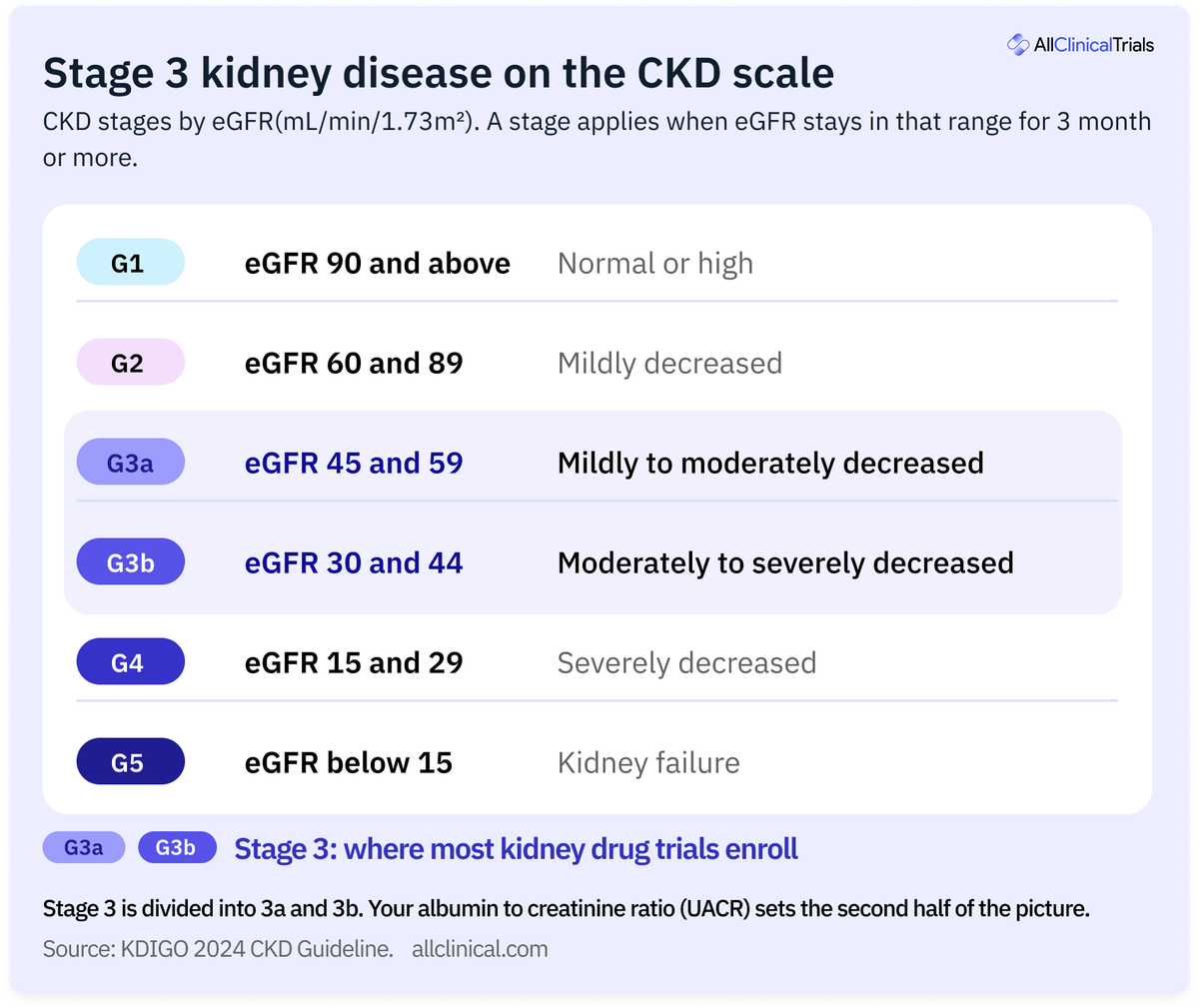
eGFR is only half of the staging. The other half is the amount of albumin, a protein, leaking into your urine, measured as the urine albumin to creatinine ratio, or UACR. Two people with the same eGFR of 50 can face very different risks depending on whether their UACR is below 30 mg/g or above 300, which is why your doctor checks both and why trials ask for both.
Stage 3 kidney disease symptoms
Usually there are none, especially at stage 3a. That is why so many people are surprised by the diagnosis: the kidneys have a large reserve, and the first sign is often a routine blood test rather than a feeling. When symptoms do appear, more often at stage 3b, they are vague: tiredness, urinating more or less often than usual, dry or itchy skin, nausea, loss of appetite, swelling in the ankles, or muscle cramps. Feeling fine is not evidence that your kidneys are fine, and the absence of symptoms is exactly why follow up testing matters.
Stage 3 kidney disease life expectancy: what the research actually shows
This is the question most people search, and the honest answer is more reassuring than most expect. Most people with stage 3 kidney disease never reach kidney failure. In a community based study that followed people from the point their stage 3 to 5 CKD was first identified, about 11 percent went on to dialysis, and a large US study found that fewer than 2 percent of people with CKD at any stage other than stage 4 progressed to kidney failure over five years. The larger risk at stage 3 is not the kidneys stopping but the heart: in that same study, more than three times as many people died as reached dialysis, with heart and blood vessel disease the most common cause of death. In practice, stage 3 kidney disease is a signal to protect your heart and blood vessels as much as your kidneys.
Two things predict who progresses. The first is albuminuria: the more protein in the urine, the higher the risk of both kidney failure and heart disease, which is why UACR is tracked so closely. The second is how fast eGFR is falling, which is why a trend over several tests tells your doctor more than any single number. Life expectancy depends on age, cause, blood pressure, diabetes, and how well these risks are controlled, so your own clinician's view matters more than any average.
Can stage 3 kidney disease be reversed?
Lost kidney function usually does not come back, so stage 3 is not reversed in the strict sense. But progression can be slowed and in many people stopped, and eGFR can rise a little when a treatable cause is fixed, such as uncontrolled blood pressure, a medicine that strains the kidneys, or a temporary injury. The realistic goal at stage 3 is stable numbers for years, and that has become much more achievable than it was a decade ago.
What slows stage 3 kidney disease
Blood pressure control. High blood pressure both causes and accelerates kidney disease, and keeping it at target is the foundation of everything else; see our high blood pressure page.
ACE inhibitors and ARBs. Medicines such as lisinopril, ramipril, losartan, and valsartan lower blood pressure and reduce protein leakage in the kidneys. International kidney guidelines recommend them for people with CKD and albuminuria who have diabetes, and for those without diabetes when albuminuria is high (UACR above 300 mg/g), and suggest them when it is moderate. Trials show they cut proteinuria within months. A small early rise in creatinine after starting one is expected and is usually monitored rather than a reason to stop.
SGLT2 inhibitors. Dapagliflozin and empagliflozin, first developed for diabetes, are now recommended for people with CKD and an eGFR of 20 or more when UACR is 200 mg/g or higher, when they have type 2 diabetes or heart failure, and suggested for people with an eGFR of 20 to 45 even when albuminuria is lower, because large trials showed they slow eGFR decline.
Finerenone. For people with type 2 diabetes, an eGFR of 25 or more, and normal potassium who still have albuminuria despite an ACE inhibitor or ARB, guidelines suggest this newer medicine, which reduced kidney and heart events in trials.
Treating the cause and avoiding damage. Keeping blood sugar at target in diabetes, stopping smoking, and avoiding regular use of anti inflammatory painkillers such as ibuprofen and naproxen, which can strain the kidneys. Any change to your medicines should be made with your doctor.
Which tests to track at stage 3
Two numbers: eGFR and UACR. Guidelines recommend checking both at least once a year at stage 3a when albumin levels are normal, at least twice a year at stage 3b, and three or more times a year when albuminuria is higher or eGFR is falling. Ask for your actual values rather than "it's a bit low," and keep them, because the trend over time is what tells you and your doctor whether treatment is working. A blood potassium level is usually checked too, especially on an ACE inhibitor, ARB, or finerenone.
How to find a stage 3 kidney disease study
AllClinicalTrials.com lists chronic kidney disease studies recruiting across the US, and you can filter them by location and check the basic criteria before applying. Right now that includes a group of three studies for adults with chronic kidney disease or protein in the urine who are not on dialysis, several of them designed for people whose blood pressure is already treated with an ACE inhibitor or ARB, such as lisinopril or losartan.
The application takes about 5 minutes: you answer questions about your diagnosis, current medicines, and recent test results, and if a study near you looks like a match, the research team contacts you. Nothing is decided until you have gone through informed consent, and participation is voluntary at every step.
Three things to have ready: your most recent eGFR, your urine albumin to creatinine ratio if it has been tested, and the name and dose of your blood pressure medicine. Those three answers decide eligibility for most kidney studies.
Common questions
Is stage 3 kidney disease serious? It is a real diagnosis that needs follow up, but it is not kidney failure, and most people at stage 3 never reach dialysis. The main risks are gradual progression and heart disease, and both can be reduced with treatment.
What is the difference between stage 3a and 3b? Stage 3a is an eGFR of 45 to 59; stage 3b is 30 to 44. Risk of progression and complications is higher at 3b, and some treatments and trials are specific to one or the other.
Does lisinopril protect the kidneys? Yes, for people with albuminuria. Lisinopril and other ACE inhibitors, like ARBs such as losartan, lower pressure inside the kidney's filters and reduce protein leakage, and guidelines recommend them for CKD with albuminuria. A small rise in creatinine when starting is expected and is monitored.
Is Jardiance or Farxiga used for kidney disease? Yes. These SGLT2 inhibitors are approved and recommended to slow chronic kidney disease in many adults, with or without diabetes, after large trials showed slower kidney decline and fewer heart events. Treatment is usually started at an eGFR of 20 or more (25 or more for Farxiga).
Can I still join a trial if I take blood pressure medicine? Usually that is exactly what trials want. Many kidney drug trials require that you already take an ACE inhibitor or ARB at a stable dose, because the study medicine is tested on top of standard care.
What should I avoid with stage 3 kidney disease? Regular use of anti inflammatory painkillers such as ibuprofen and naproxen, dehydration, smoking, and uncontrolled blood pressure or blood sugar. Ask a pharmacist before new supplements or over the counter medicines, since some are cleared by the kidneys.
How often should I be tested? At least once a year at stage 3a with normal albumin levels, at least twice a year at stage 3b, and three or more times a year if albuminuria is higher or eGFR is falling, according to kidney guidelines. Your doctor sets the schedule based on your results.
Will stage 3 kidney disease turn into stage 4? Not for most people, especially with treatment. Progression is most likely when albuminuria is high, blood pressure or diabetes is uncontrolled, or eGFR is already falling fast, which is why those are the things treatment and trials target.
See chronic kidney disease clinical trials recruiting now
Browse open studies, filter by location, and apply in about 5 minutes: Chronic Kidney Disease Clinical Trials.

Our guide to CKD stages and treatment options covers every stage.