
You opened your blood test results and one line is flagged: creatinine, high. It is one of the most common flags on a routine panel, and one of the most misunderstood. A high creatinine can mean your kidneys are filtering less well, or it can mean you are muscular, a little dehydrated, or taking a creatine supplement. Meanwhile about 37 million American adults have chronic kidney disease, and nearly 9 in 10 of them do not know it, often because nobody explained what that one number meant. This guide shows you how to read your result, why your age and sex change its meaning, when a high creatinine needs attention, and what actually lowers it.
Looking for treatment options for kidney disease?
Browse open clinical trials near you! We'll handle the follow-up.
What does high creatinine mean?
Creatinine is a waste product made when your muscles use energy. It enters the blood at a fairly steady rate, and healthy kidneys filter it out into the urine. Because production is steady, the amount left in the blood is a useful signal of how well the kidneys are filtering. When filtering slows, creatinine builds up and the number rises. That is why a test for high creatinine in blood is the first one doctors use to check kidney function.
But the number has two sides. It depends on how much creatinine your body makes, not only on how well your kidneys clear it. People with more muscle make more, so a muscular man can sit above the lab range with perfectly healthy kidneys, while a frail older adult with little muscle can have a "normal" creatinine and reduced kidney function. That is why doctors almost never read creatinine alone. They convert it into an estimated glomerular filtration rate, or eGFR, which adjusts for age and sex, and they often add a urine test for protein.
Normal creatinine levels and a creatinine levels chart
Each lab sets its own reference range, so always check the range printed beside your result. Typical adult ranges look like this.
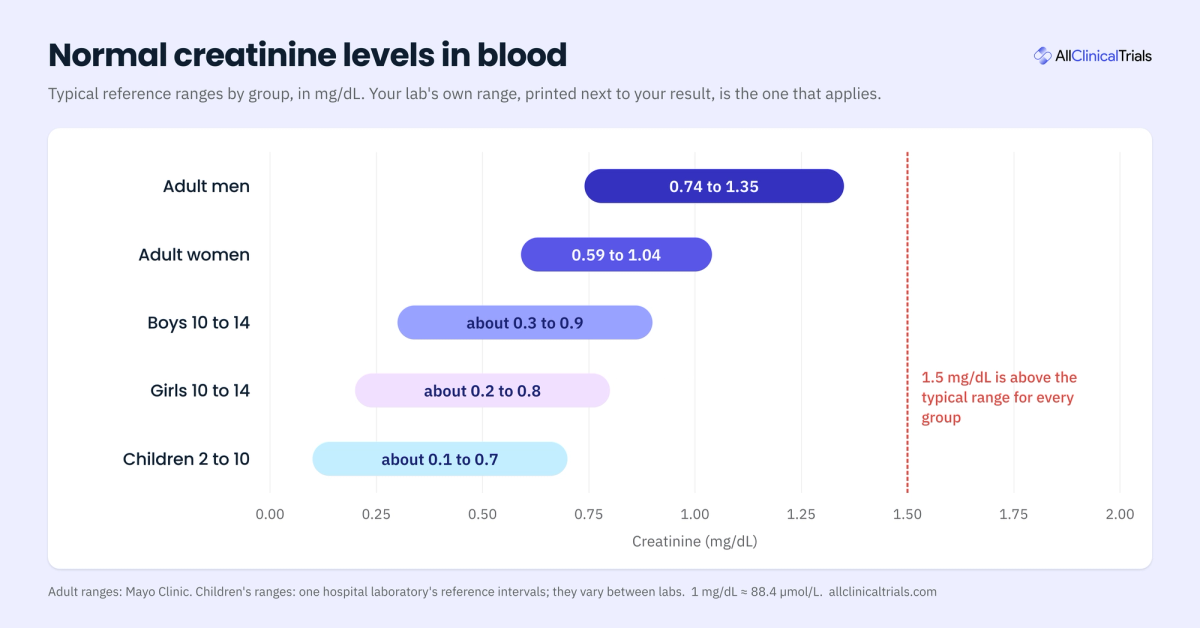
Chart of normal creatinine ranges in mg/dL for adults and children
Normal creatinine levels by age: why the same number means different things
Here is the part most charts leave out. For adults, the normal creatinine range does not change with age. What changes is what a given number means. Kidney function naturally declines with age, and the eGFR equation used by US labs since 2021, called CKD-EPI 2021, accounts for that and for sex. Run the same creatinine through it for different people and you get very different kidney function estimates.
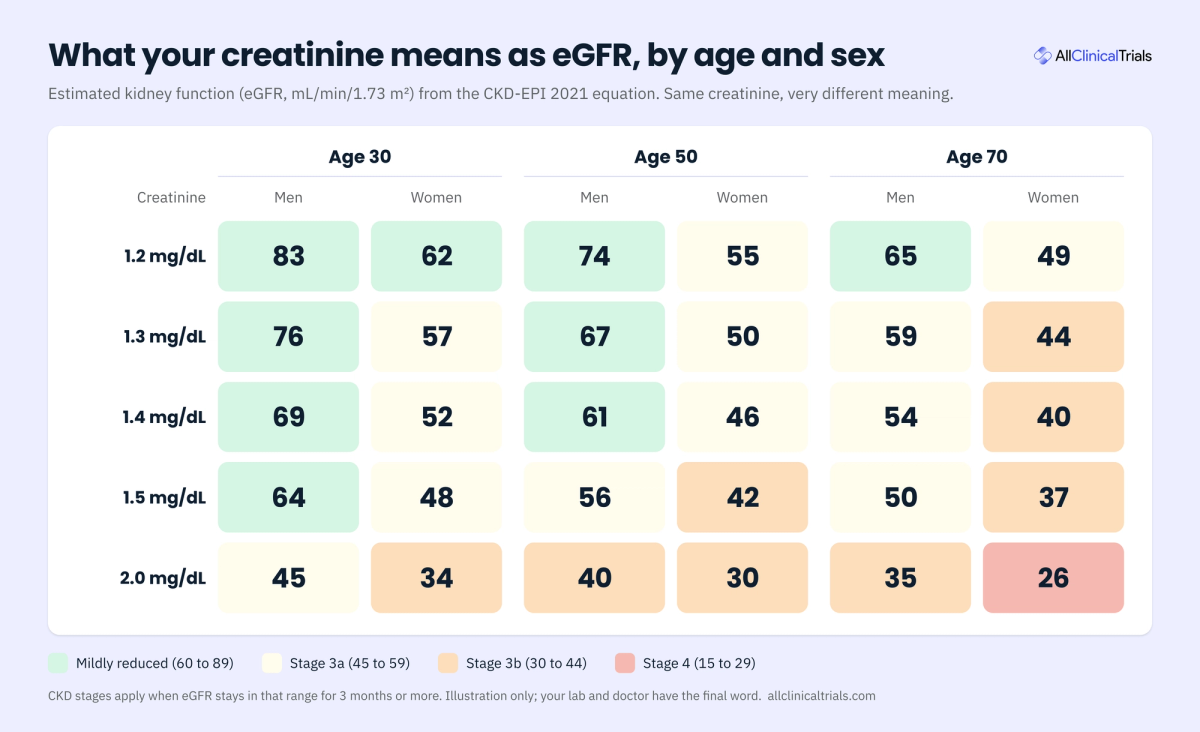
Table of eGFR values by creatinine, age and sex from the CKD-EPI 2021 equation
So a creatinine of 1.5 is just above the range for a man and well above it for a woman, but the more important question is the eGFR. For a 30 year old man it works out to about 64, mildly reduced. For a 70 year old woman it is about 37, which falls in stage 3 chronic kidney disease. Our guide to CKD stages explains what each stage means for treatment.
What causes high creatinine?
Temporary, often harmless causes. Dehydration, a hard workout in the day or two before the test, a large meal of cooked meat, and creatine supplements can all push creatinine up. A 2025 meta-analysis found creatine supplements raise blood creatinine slightly without reducing actual kidney filtration, because creatine is converted into creatinine. A few prescription medicines also raise the number by blocking how the kidneys release creatinine, without harming the kidneys; your pharmacist can tell you if one of yours does.
Sudden kidney injury. Severe dehydration, infections, blocked urine flow such as from an enlarged prostate or a kidney stone, and some medicines, including regular high doses of anti inflammatory pain relievers, can injure the kidneys quickly. This is called acute kidney injury and is often reversible if the cause is found.
Chronic kidney disease. A slow, lasting loss of filtering ability. In the US, diabetes and high blood pressure cause about 2 in 3 cases of kidney failure. About 4 in 10 people with diabetes and 1 in 5 with high blood pressure have kidney disease.
Specific kidney diseases. Inflammatory and genetic conditions such as IgA nephropathy, focal segmental glomerulosclerosis, lupus nephritis, and polycystic kidney disease, often found because creatinine or urine protein is abnormal. See our glomerulonephritis page.
Muscle breakdown. Rarely, severe muscle injury releases large amounts of creatinine and other substances at once and can damage the kidneys.
High creatinine symptoms
Usually there are none. Early kidney disease is silent, which is exactly why so many people with it are unaware, and the CDC notes that blood and urine tests are the only reliable way to find it. Symptoms tend to appear only when kidney function is quite low: swelling in the ankles, feet, or around the eyes, tiredness, trouble concentrating, needing to urinate more or less often, foamy urine, nausea, itching, muscle cramps, and shortness of breath. Feeling fine is not a reason to ignore a high result.
When to worry about creatinine levels
A high creatinine on a single test is common and often settles on a repeat. What matters is the pattern. Get care promptly if your creatinine has risen quickly. Doctors define acute kidney injury by change, not height: a rise of 0.3 mg/dL or more within 48 hours, or to one and a half times a recent baseline within a week. Seek urgent care if a high result comes with very little urine, new swelling, shortness of breath, confusion, or vomiting.
Follow up soon if your eGFR is below 60, if your urine shows protein, or if you have diabetes, high blood pressure, or a family history of kidney failure. A single high result is usually repeated, often with a urine albumin test and sometimes a cystatin C test, which is not affected by muscle mass. Chronic kidney disease is diagnosed when eGFR stays below 60, or kidney damage markers persist, for at least three months.
Ask about a kidney specialist if your eGFR is below 30, or falling quickly, since that is when referral to a nephrologist is usually recommended. An eGFR below 15 is kidney failure.
Probably less urgent if a mildly high result is stable over time, your eGFR is above 60, your urine is normal, and there is an obvious explanation such as a muscular build or creatine use. Still, let your doctor make that call.
How to lower creatinine levels
The honest answer is that you lower creatinine by dealing with what raised it, not by chasing the number. If a temporary cause is likely, doctors often simply repeat the test after you have been well hydrated, avoided hard exercise and a large meat meal for a day or two, and, if relevant, paused creatine supplements, which they may ask you to do. If a medicine may be the cause, do not stop it on your own; ask your prescriber.
If the cause is kidney disease, the goal shifts from the number to protecting the kidneys you have, and that has improved dramatically. Controlling blood pressure and blood sugar is the foundation. Several medicines now slow kidney disease itself: blood pressure drugs in the ACE inhibitor and ARB families, SGLT2 inhibitors such as dapagliflozin and empagliflozin, finerenone for kidney disease with type 2 diabetes, and, since January 2025, semaglutide (Ozempic), which in the FLOW trial of 3,533 adults with type 2 diabetes and kidney disease cut the risk of serious kidney and heart outcomes by 24 percent. These are prescription decisions; supplements and detox products have no proven effect on kidney function, and some can harm it.
Why a high creatinine result can make you a good candidate for research
This is the part most lab guides never mention. Kidney research needs people with exactly your result, and there are three distinct routes in.
Kidney disease with diabetes or high blood pressure. Large Phase 3 trials are testing medicines that protect the kidneys and heart, at more than a hundred US sites each. They usually want people with an eGFR in a set range and often protein in the urine. See our chronic kidney disease clinical trials and diabetic nephropathy pages.
Specific kidney diseases. If a kidney biopsy or specialist has named a cause, such as IgA nephropathy or FSGS, there are targeted Phase 2 and 3 trials for it, some of the most active areas of kidney research.
Kidney function studies for new medicines. Because many drugs leave the body through the kidneys, drug developers routinely test how a new medicine behaves in people whose kidney function is reduced, comparing them with healthy volunteers matched for age and weight. These are usually short, closely monitored studies, often with a stay at a research unit, and they need people with mild, moderate, or severe reduction in eGFR who are otherwise stable. A creatinine like 1.5 can be exactly what they are looking for. See our healthy volunteers page for how these studies work.
Studies recruiting now
A Phase 3 trial of baxdrostat with dapagliflozin from AstraZeneca measures kidney and heart outcomes in adults with chronic kidney disease and high blood pressure at 116 US sites. A Phase 3 trial of mezagitamab from Takeda enrolls adults with IgA nephropathy and an eGFR above 30 at 41 US sites, and a Phase 3 trial of BI 764198 from Boehringer Ingelheim enrolls adults and adolescents with FSGS at 46 US sites. For kidney function studies of new medicines, a Phase 1 study enrolls both healthy participants and people with reduced kidney function, ages 18 to 85, to see how a new medicine is handled by the body. Each listing gives the exact eGFR range it needs, and applying takes about 5 minutes.
Common questions
Is creatinine 1.5 bad? It is above the typical range for both men and women, but whether it signals kidney disease depends on your age, sex, and muscle mass, which is why it is converted to eGFR. For a 30 year old man it corresponds to an eGFR of about 64; for a 70 year old woman, about 37. Your doctor will usually repeat it and add a urine test.
Can dehydration cause high creatinine? Yes. Less fluid means less blood flow through the kidneys, so creatinine rises, usually returning to normal once you are rehydrated. Severe dehydration can also injure the kidneys, which is why a retest after rehydration is common.
What creatinine level is dangerous? There is no single cutoff, because the meaning depends on the person. A rapid rise is more concerning than a high stable value, and doctors act on eGFR: below 60 for three months is chronic kidney disease, below 30 usually means a specialist, and below 15 is kidney failure.
Can high creatinine go back to normal? Often, when the cause is temporary or an acute injury that is treated. In chronic kidney disease, lost function usually does not return, but treatment can slow or stop further decline, which is what most kidney trials aim to improve.
See kidney disease clinical trials recruiting now
Browse open studies, filter by location, and apply in about 5 minutes: Chronic Kidney Disease Clinical Trials